
Tennis
Swiatek vs Anisimova: Where the Wimbledon Women’s Final Will Be Decided

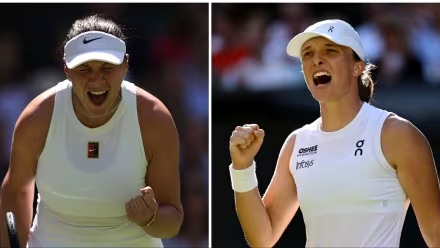
As anticipation builds for Saturday’s Wimbledon women’s singles final, BBC Sport analyst and former WTA top-60 player Naomi Broady shares her insights on how the showdown between Iga Swiatek and Amanda Anisimova might unfold.
It’s a clash between two compelling stories: Swiatek, a five-time Grand Slam champion still seeking her first Wimbledon crown, and Anisimova, a resurgent former prodigy who stepped away from the sport to focus on her mental health and is now reaching new heights.
Here’s where Broady believes the match could be won or lost.
Nerves Will Play a Big Role
The pressure of a Wimbledon final is immense, and how each player handles the moment may prove decisive. Anisimova showed visible nerves in her quarter-final against Anastasia Pavlyuchenkova, often crouching down between points—even when it wasn’t match point—such was her tension.
While she appeared more composed during her semi-final victory over Aryna Sabalenka, the emotions of the occasion are sure to return on Saturday.
Swiatek, meanwhile, brings with her the experience of multiple major titles and a long stint as world number one. That familiarity with the biggest stages could be crucial. Still, the stakes may weigh heavier on her shoulders. Unlike Anisimova, who is playing with the freedom of someone few expected to be in the final, Swiatek arrives with the expectation to win.
That underdog role could empower Anisimova to swing more freely and play with fearless aggression—traits that align perfectly with her high-risk, high-reward style.
Knowing Each Other Well
Though they’ve never faced off on the professional tour, Swiatek and Anisimova aren’t strangers. They’ve played in juniors and likely trained together over the years. That familiarity removes the element of surprise often seen in Grand Slam finals.
Both players will have detailed match plans from their teams, but neither will be scrambling to learn about their opponent’s tendencies. Their shared history could help both settle into the match more quickly.
Why Grass Courts Create New Champions
For the eighth consecutive year, Wimbledon will crown a first-time women’s singles champion. The unique nature of the grass-court season may explain this trend. With just a brief window between the clay of Roland Garros and the grass of SW19, many players arrive at Wimbledon without much preparation.
Interestingly, those who exit early from the French Open often gain an advantage by having more time to adapt to grass. That seems to be the case for both Swiatek and Anisimova, who began their grass campaigns early and appear to have adjusted well to the surface.
A Tactical Battle of Strengths
Expect a fascinating tactical duel centered around Anisimova’s explosive backhand and Swiatek’s signature topspin forehand.
Anisimova will aim to dictate with early, aggressive shot-making—particularly off the backhand wing. Her ability to step inside the baseline and flatten out her strokes makes her a dangerous opponent, especially against players like Swiatek who prefer constructing points.
Historically, Swiatek has struggled against flat-hitting power players such as Jelena Ostapenko, and Anisimova will try to follow a similar blueprint. She must remain bold, even under pressure, to disrupt Swiatek’s rhythm.
On the other side of the net, Swiatek has evolved tactically during the grass season. By standing slightly deeper behind the baseline, she has gained the extra milliseconds needed to wind up her forehand—a shot that wreaks havoc on clay. She’s also been using angles effectively, often drawing opponents wide before exploiting open space.
Whether these tactics will succeed against Anisimova’s backhand remains to be seen, but one thing is certain: both players are in top form and ready to leave it all on Centre Court.






Tielemans’ extra-time penalty completes stunning Belgium comeback against Senegal

Morocco beat Netherlands on penalties to reach World Cup last 16 after dramatic comeback

Germany crash out as Paraguay win dramatic penalty shootout to reach World Cup last 16

Martinelli’s last-gasp strike sends Brazil into World Cup last 16

Ronaldo fails to match rivals’ World Cup heroics as Portugal held by DR Congo

Kane double and Bellingham brilliance fire England past Croatia in World Cup opener

BREAKING: Messi scores first ever world cup hat-trick to become the highest goalscorer surpassing Miroslav Klose

Haaland double powers Norway past Iraq in World Cup opener

Mbappe breaks France scoring record as Les Bleus defeat Senegal in World Cup opener

Kamada’s late heroics earn Japan draw against Netherlands in World Cup opener

Havertz scores brace as Germany put seven past World Cup debutants Curacao
