
Premier League
Arsenal win the English Premier League to end 22-Year wait for Premier League glory


Arteta’s vision, smart recruitment and a united club culture drive Gunners back to the summit, Arsenal’s return to the top of English football has been shaped by far more than results on the pitch. From motivational messages and symbolic fires at the training ground to an AI-generated dressing-room anthem, Mikel Arteta’s side have embraced an unconventional path on their way to ending a 22-year wait for the Premier League title, Sport360NG reports.
The Gunners were officially crowned champions on Tuesday after Manchester City were held to a 1-1 draw by Bournemouth, confirming Arsenal as England’s new kings following a campaign built on resilience, planning and belief.

While the title triumph may appear sudden, it is in fact the culmination of a project that has been carefully developed over the past six years under Arteta’s leadership.
‘Trust the process’ finally pays off
When Arteta urged supporters to “trust the process” back in 2020, the phrase quickly became attached to Arsenal’s rebuilding project. Now, with silverware finally secured, those words have gained new significance.

The Spaniard has transformed Arsenal into one of Europe’s most complete sides, overseeing a cultural reset as much as a footballing one.
Arteta’s attention to detail has extended beyond tactics. During a difficult spell last month, he reportedly asked players to imagine throwing their negative thoughts into a fire lit at the club’s London Colney training base, a symbolic gesture aimed at resetting minds during the tense closing weeks of the title race.
The manager has also regularly organised barbecues involving players, staff and families, reinforcing togetherness and unity within the squad.
That collective spirit proved vital as Arsenal overcame setbacks, including a painful Carabao Cup final defeat to Manchester City, to eventually emerge as champions.

Recruitment strategy reshapes Arsenal
Much of Arsenal’s success has come from smart recruitment and long-term planning behind the scenes.
Former sporting director Edu played a major role in assembling the squad before his departure in 2024, while figures such as Jason Ayto, James Ellis and head of football intelligence Mark Curtis were heavily involved in reshaping the club’s football structure.
Ten of Arsenal’s 15 most-used Premier League players this season arrived during Edu’s tenure, highlighting the importance of recruitment in the club’s resurgence.

Chief executive Richard Garlick also backed the rebuilding strategy after joining from the Premier League in 2021, while co-chairman Josh Kroenke became increasingly involved in football operations throughout the campaign.
Kroenke reportedly made several visits to London Colney during the season, maintaining close contact with staff, players and supporters as Arsenal pushed for the title.
Academy products continue to shine
Arsenal’s academy has also remained central to the club’s identity.
Bukayo Saka once again starred for the first team, while youngsters Myles Lewis-Skelly, Ethan Nwaneri and Max Dowman further highlighted the strength of the Hale End production line.

Dowman, in particular, enjoyed a remarkable breakthrough season. Still only a teenager, he became Arsenal’s youngest Premier League scorer and youngest Champions League player after earning Arteta’s trust.
His rise has drawn widespread praise within football circles, with many scouts viewing him as one of the finest young talents to emerge from the academy system in years.
Tactical evolution and Arteta’s bold calls
Arteta’s growth as a manager has mirrored Arsenal’s development as a team.
Known for his demanding standards and intense personality, the Spaniard has gradually become more willing to trust instinct and emotion in key moments.
One such decision backfired when Kepa Arrizabalaga was selected for the Carabao Cup final, with the goalkeeper’s costly error contributing to defeat against City.
However, Arsenal responded positively to setbacks and appeared mentally stronger during the decisive months of the campaign.
Innovation also became part of the club’s identity. An AI-generated song featuring the names of every squad member became a favourite inside the dressing room, with Arteta’s trademark phrase, “make it happen”, forming part of the lyrics.
By season’s end, Arsenal had done exactly that.
Berta’s arrival and the Gyokeres effect
The appointment of Andrea Berta as sporting director in March 2025 proved another turning point.
Berta, who replaced Edu after the Brazilian’s move to Nottingham Forest’s ownership group, arrived with a clear objective, turning Arsenal from contenders into champions.
One of his biggest moves was securing striker Viktor Gyokeres, whose signing changed the dynamic of Arsenal’s attack.
Although Arsenal had monitored players such as Benjamin Sesko, Alexander Isak and Julian Alvarez, the club eventually prioritised Gyokeres because of his immediate impact potential.
Arteta initially needed convincing before approving the deal, but the Swedish forward eventually became central to Arsenal’s title-winning run.
After a slow adaptation period, Gyokeres exploded into form following the March international break and finished the season with 21 goals in all competitions.
His movement behind defences also prompted Arsenal to adopt a more direct attacking style at times during the season.
Defensive solidity key to title charge
While Gyokeres strengthened Arsenal going forward, the club’s defensive consistency laid the platform for success.
William Saliba and Gabriel Magalhaes developed into one of Europe’s strongest central defensive partnerships, while Declan Rice continued to establish himself as one of the Premier League’s most influential midfielders.
Rice played more minutes than any Arsenal outfielder this season and remained a driving force despite the physical demands of competing across multiple competitions.
Goalkeeper David Raya also delivered consistently strong performances during the title run-in.
Ultimately, Arsenal’s triumph was built on balance rather than dependence on a single superstar.
Attention already turning to the future
Despite finally reclaiming the Premier League crown, Arsenal’s work is far from complete.
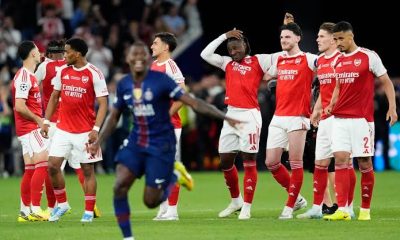
The club remain determined to challenge for the Champions League when they face Paris Saint-Germain in Budapest later this month, while preparations for next season are already underway behind the scenes.
Talks over a new contract for Arteta are expected to intensify after the European final, with Arsenal keen to reward the manager after delivering the club’s first league title since 2004.
The Gunners are also planning further squad adjustments this summer. Reinforcements in midfield, attack and wide areas are being considered, though there is expected to be a greater focus on player sales after last year’s heavy spending.
Defender Jakub Kiwior is already set to join Porto, while Arsenal may also listen to offers for several senior players as they attempt to keep the wage structure under control.
At the same time, the club continue to invest heavily in youth, with Leicester City prospect Jeremy Monga among the names being monitored.
Legacy now the next objective
For Arteta, delivering one title is only the beginning.
The Arsenal manager has repeatedly spoken about creating a lasting dynasty rather than enjoying a single successful season, and there is growing belief within the club that this squad can dominate for years to come.
After years of near misses and rebuilding, Arsenal have finally returned to the summit of English football.
Now, the challenge will be staying there.





Tielemans’ extra-time penalty completes stunning Belgium comeback against Senegal

Morocco beat Netherlands on penalties to reach World Cup last 16 after dramatic comeback

Germany crash out as Paraguay win dramatic penalty shootout to reach World Cup last 16

Martinelli’s last-gasp strike sends Brazil into World Cup last 16

Ronaldo fails to match rivals’ World Cup heroics as Portugal held by DR Congo

Kane double and Bellingham brilliance fire England past Croatia in World Cup opener

BREAKING: Messi scores first ever world cup hat-trick to become the highest goalscorer surpassing Miroslav Klose

Haaland double powers Norway past Iraq in World Cup opener

Mbappe breaks France scoring record as Les Bleus defeat Senegal in World Cup opener

Kamada’s late heroics earn Japan draw against Netherlands in World Cup opener

Havertz scores brace as Germany put seven past World Cup debutants Curacao
