
Nigerian Football
Nigeria football federation expresses displeasure over refereeing standards, calls for urgent reform


The Nigeria Football Federation (NFF) has expressed grave concern over the poor performances of the country’s football referees, which led to their exclusion from officiating at the upcoming 2025 Africa Cup of Nations (AFCON) in Morocco. This came to light following the NFF Executive Committee’s meeting in Abuja on Wednesday, where the state of officiating in Nigeria’s domestic football leagues was heavily scrutinized, Sport360NG reports.
In a statement released on Thursday, the NFF revealed that the assessment of referees across the Nigeria Premier Football League (NPFL), Nigeria National League (NNL), Nigeria Women’s Football League (NWFL), and Nationwide League One (NL1) showed deep dissatisfaction with their performances. The NFF warned that stricter measures will be implemented to tackle issues such as incompetence, corruption, and manipulation in match officiating.
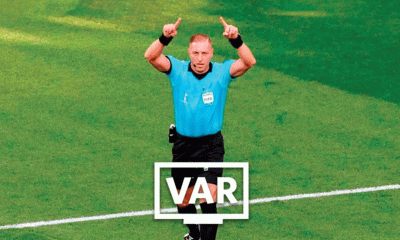
The exclusion of Nigerian referees from the 2025 AFCON was a direct result of their failure to meet the Confederation of African Football’s (CAF) standards. In October, CAF announced the selection of 94 officials for a preparatory course ahead of the tournament, but none were from Nigeria. The list was later reduced to 73 for the final tournament roster. Sources suggest that CAF’s selection was based on both fitness and proficiency in using the Video Assistant Referee (VAR) system, an area where Nigerian officials have been notably lacking.
To address these shortcomings, the NFF has committed to working with stadium authorities to equip facilities with VAR technology. NFF General Secretary Dr. Mohammed Sanusi stated that while the federation does not own the stadiums, it is actively seeking to collaborate with government agencies to install the necessary infrastructure.
In response to Nigeria’s exclusion from the AFCON officiating list, Nigeria Referees Association President Sanni Zubair acknowledged that the country’s referees had not met the required criteria, highlighting that Nigeria currently has only one elite referee capable of being considered. Zubair emphasized that becoming a FIFA-certified referee does not automatically qualify one for the elite category.
“Each year, we have courses and exams, and hopefully, more referees will meet the criteria for elite tests soon,” Zubair said.
Despite these challenges, a FIFA-badged referee, who spoke on condition of anonymity, expressed confidence in the ability of Nigerian referees to officiate at the continental level. He called for more support from the NFF and stressed the importance of practical VAR experience for officials, noting that while training is available, there is a critical need for more hands-on practice.
“Other countries may have two or three referees at the elite level, but that doesn’t mean they are necessarily better. Our referees are still regularly called up for CAF assignments, and with more support, we can get back on track,” the anonymous referee stated.
With ongoing efforts to improve the standard of officiating in Nigerian football, the NFF is hoping that future reforms, including increased use of VAR and better referee development programs, will restore Nigeria’s standing in international football officiating.








Tielemans’ extra-time penalty completes stunning Belgium comeback against Senegal

Morocco beat Netherlands on penalties to reach World Cup last 16 after dramatic comeback

Germany crash out as Paraguay win dramatic penalty shootout to reach World Cup last 16

Martinelli’s last-gasp strike sends Brazil into World Cup last 16

Ronaldo fails to match rivals’ World Cup heroics as Portugal held by DR Congo

Kane double and Bellingham brilliance fire England past Croatia in World Cup opener

BREAKING: Messi scores first ever world cup hat-trick to become the highest goalscorer surpassing Miroslav Klose

Haaland double powers Norway past Iraq in World Cup opener

Mbappe breaks France scoring record as Les Bleus defeat Senegal in World Cup opener

Kamada’s late heroics earn Japan draw against Netherlands in World Cup opener

Havertz scores brace as Germany put seven past World Cup debutants Curacao
