
European Football
A Quarter Century Later, Mourinho Reunites with Benfica


It has been a quarter of a century since José Mourinho last stood on the touchline as Benfica manager. In the years that followed his brief 11-game spell in Lisbon, the “Special One” scaled football’s highest peaks, collecting Champions League trophies with Porto and Inter Milan, league titles across four countries, and a catalogue of silverware that placed him among the game’s most decorated coaches, Sport360NG reports.
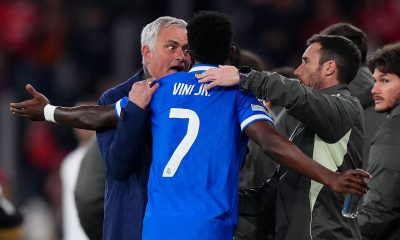
Now 62, Mourinho is back at Benfica, stepping into a very different Estadio da Luz than the one that existed in 2000. His arrival has sparked excitement, nostalgia, and political debate in equal measure.
Legacy and Aura
Mourinho remains a revered figure in Portugal, especially for his achievements with Porto, where he delivered a UEFA Cup and Champions League in consecutive seasons. His career path also took him to Chelsea, Real Madrid, Inter, and Manchester United, clubs where his fiery charisma, tactical acumen, and success left lasting marks.
“His legacy is enormous here,” noted CNN journalist João Pedro Oca, reporting outside Benfica’s stadium. “We’ve been waiting for his return for years. Everyone knew it was a matter of time before Mourinho came back to Portugal, first Benfica, maybe eventually the national team.”
Yet, the glow of Mourinho’s peak has dimmed. His last league title came with Chelsea a decade ago, and his most recent silverware was the Europa Conference League with Roma in 2022.
Unfinished Business
Mourinho’s first stint at Benfica ended abruptly in December 2000 when, just weeks into his tenure, he resigned after failing to secure backing from the newly elected president, Manuel Vilarinho. At the time, he had guided the struggling side to six wins in 11 matches, showing flashes of the brilliance that later made him a household name.
“Even in those few months, you could already see the Mourinho we came to know later at Porto and Chelsea,” recalled Filipe Inglês, host of the Benfica FM podcast. “Fans felt a sense of injustice when he left.”
That sense of unfinished business makes his return all the more symbolic.
Politics in Play
This second spell, however, arrives against a turbulent backdrop. Benfica president Rui Costa, once a star for the club on the pitch, is facing elections on 25 October. Critics suggest Mourinho’s appointment is a calculated gamble to boost his re-election chances.
“Peak Mourinho is gone, and everyone knows his confrontational style,” said Diogo Pombo of Expresso. “But his connection to Benfica, and the fact that he left under such strange circumstances, works in his favour.”
Polls currently place Costa behind rival candidates, raising questions about whether Mourinho could find himself working under new leadership within weeks.
“The risk is on both sides,” added Oca. “If Costa loses, the next president inherits an expensive, high-profile manager. If Mourinho fails to deliver quickly, the whole move will be remembered as a political stunt.”
A High-Stakes Reunion
Despite the doubts, the excitement is undeniable. Mourinho still boasts one of the best win ratios of his career at Fenerbahçe, where he left earlier this summer, though he was dismissed after a Champions League exit, ironically against Benfica.
For many supporters, his return is about more than statistics; it’s about restoring aura and ambition.
“If you told me five or ten years ago Mourinho was coming, I’d be ecstatic,” Inglês admitted. “He’s the greatest Portuguese manager of all time. But the big question now is whether he’s still capable of being that Mourinho.”
Benfica fans will demand nothing less than a title. Anything short, given Mourinho’s status and salary, will be considered failure.
For Mourinho, the return offers the chance to close an unfinished chapter. For Rui Costa, it could be a last throw of the dice before elections. And for Portuguese football, it brings back one of its most iconic and divisive characters to centre stage.




Tielemans’ extra-time penalty completes stunning Belgium comeback against Senegal

Morocco beat Netherlands on penalties to reach World Cup last 16 after dramatic comeback

Germany crash out as Paraguay win dramatic penalty shootout to reach World Cup last 16

Martinelli’s last-gasp strike sends Brazil into World Cup last 16

Ronaldo fails to match rivals’ World Cup heroics as Portugal held by DR Congo

Kane double and Bellingham brilliance fire England past Croatia in World Cup opener

BREAKING: Messi scores first ever world cup hat-trick to become the highest goalscorer surpassing Miroslav Klose

Haaland double powers Norway past Iraq in World Cup opener

Mbappe breaks France scoring record as Les Bleus defeat Senegal in World Cup opener

Kamada’s late heroics earn Japan draw against Netherlands in World Cup opener

Havertz scores brace as Germany put seven past World Cup debutants Curacao
